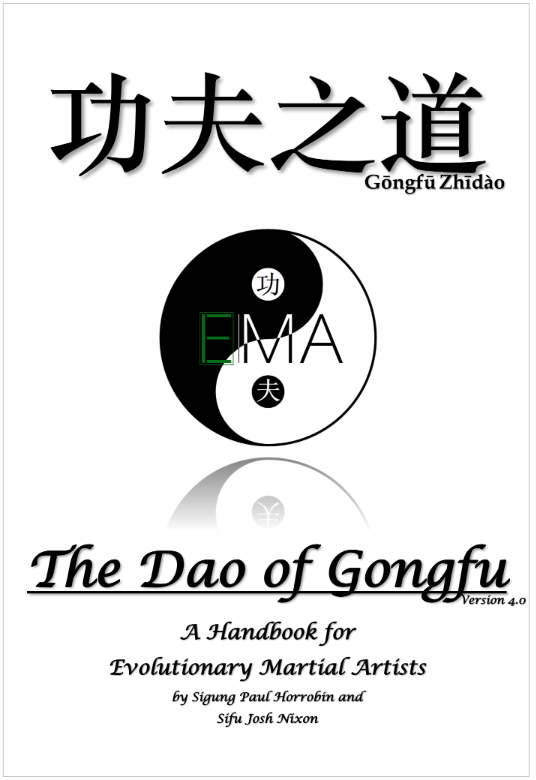
Our syllabus at Evolutionary Martial Arts reflects the journey that our students undertake. Many take the first steps on this path but few have seen it through to its end. This is because the task is a formidable one: it is a long journey which requires a level of dedication that many find difficult to find within themselves. For those who do, however, the achievement is a rewarding one indeed. You may have noticed in the image above that our syllabus displays a version number on its front cover. This is because, as with all truly progressive approaches, it is subject to revision and refinement over time. A couple of sentences ago, we mentioned the end of the journey. This is something of a misnomer, though. It is our intention that the journey to Black Sash represents the end of the beginning, rather than the end of the journey. Throughout their career, the Evolutionary martial artist progresses through their gradings and builds up a diverse and comprehensive skillset. The wearer of the Black Sash has completed the building of these solid foundations, from which they can then diversify, refine their practice and explore their chosen specialisms in much more depth.
Our syllabus gives the practitioner everything they need to become the best expression of themselves they can as a martial artist and realise their fullest potential. It could be thought of as similar to formal education:
The 3 beginners’ levels build up a good, basic and effective understanding of most conceptual aspects of martial arts, similarly to how a GCSE-level education gives a broad overview of the foundational understanding needed for further study.
The 3 intermediate levels develop this significantly, giving a much more in-depth understanding of those conceptual aspects and also adding in new ones. The level of challenge and independence as a practitioner is significantly higher, similarly to the way in which an A-level education progresses from GCSE.
The 3 advanced levels serve to much more fully and comprehensively cover all conceptual areas of martial arts, providing the practitioner with a great breadth and depth of understanding. By this stage, they are approaching expert-level practice, similar in breadth and depth to those who would hold an undergraduate degree in a subject.
The Black Sash represents years of dedication, hard work and diligent practice, and represents a level of true mastery and expertise across the whole breadth and depth of what it is to be a martial artist. Some would liken this to the mastery of someone who had undertaken a master’s degree, and that the scope for specialism after completing this stage (especially for those who would progress to becoming Sifu) is akin to the understanding gained through undertaking a PhD.
The following is a brief look at the path our students take through the EMA syllabus. For information on each grading, click its title. These pages give some generalised indications of the shifting focus of training at each stage, and members can of course consult their full copy of the syllabus for specific, detailed information at any time. If you have any questions, feel free to get in touch.
初学徒弟
Chūxué Túdì
Beginner Disciple
Red Sash,
Orange Sash
and
Yellow Sash
中间徒弟
Zhōngjiān Túdì
Intermediate Disciple
Green Sash,
Blue Sash
and
Purple Sash
高级徒弟
Gāojí Túdì
Advanced Disciple
Brown Sash of the First Degree,
Brown Sash of the Second Degree,
and
Brown Sash of the Third Degree
终极徒弟
Zhōngjí Túdì
Ultimate Disciple
While beginner and intermediate students gain new sashes with each grading, each of a new colour to denote their level of continued development, advanced students keep their brown sash and gain first one and then two white tags on their sash to denote their increasing expertise. Wearers of a Black Sash, however, keep their sash forever. There are no further grades to earn, and nothing in terms of visual signs to denote the difference in experience and expertise between any two wearers of the Black Sash around their waist. This is because, at that stage, their practice speaks for itself. They are the embodiment of their mastery, and their practice is its exhibition. The sash is just a piece of cloth that shows they have completed a long and extremely comprehensive introduction to Gongfu. It is up to them to live and breathe the Way as they see fit.
For further information on the different levels of mastery and associated titles, from students to instructors, click here.
For further information on gradings, click here.
For further information on taolu (forms), click here.
For further information on our principles and code of conduct, click here.
For further information on sparring, click here.
The syllabus is split into eight conceptual areas, each with their own subdivisions. They are:
打击 – Dǎjí – Striking
This encompasses both upper-body striking methods such as punches and elbow strikes, and lower-body methods such as kicks and knee strikes.
防御 – Fángyù – Defence
This encompasses all elements of damage limitation, including evasion, parrying, blocking and trapping.
擒拿 – Qínná – Biomechanical Manipulation
While all movement is really by definition “biomechanical manipulation”, it is a workable term for directly altering the structure of an attacker to compromise stability, limit effective range of motion or cause injury. This encompasses takedowns, throws, joint manipulation (including locks and breaks), grappling, clinching, soft tissue manipulation, choking and disarming, for example, as well as a lot of emphasis on escapes, counters and passes.
器械 – Qìxiè – Weapons Training
This encompasses edged, blunt, ranged and improvised weapons, with an initial focus on unarmed survival of armed assault and then a progression to learning the arts of weapon usage.
轻功 – Qīnggōng – Agility and Mobility
Qinggong translates as “light skills”, encompassing skills of evasion and escape, falling without injury and different ways of moving through the environment quickly and efficiently.
套路 – Tàolù– Forms
Forms are traditional set patterns of movements, stances and techniques that offer many benefits for a well-rounded martial artist. We have five core Forms, which are detailed in our syllabus.
散打 – Sàndǎ – Sparring
Sparring takes many forms. Beginners start with light-contact sparring (often known as touch sparring or flow sparring), and then progress to medium-contact sparring which requires protective gear as intermediate students, as well as “back-to-back” groundfighting rounds for grappling-specific training. Advanced students may progress to high-contact sparring and free sparring, which involves striking and grappling without technical restriction but with built-in safety measures to ensure that sparring does not become fighting. Health and safety is of paramount importance in sparring, and more details can be found on our guide to sparring.
杂项技巧和注释 – Záxiàng Jìqiǎo hé Zhùshì – Miscellaneous Skills and Notes
Gongfu is so vast and nebulous that many concepts do not fit neatly into any one subject area. As such, we find it useful to include a section for these things. In this section, you will often find detail on the above and specific requirements to each grading.

 Evolutionary Martial Arts